
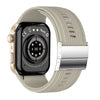
The squeeze is the tell. What an inflating watch does differently from an optical estimate — and what the 2025 AHA and 2026 ESH statements actually said.
Why Some Blood Pressure Watches Inflate — And What That Actually Means
You press a button and the watch tightens around your wrist. There's a whirr, a squeeze, and then it lets go. If you've never used one before, it's mildly startling — and it's also the single clearest signal about what kind of device you're holding.
Because that pump means something specific. It means the device isn't guessing.
Two Ways a Wearable Gets to a Number
Broadly, there are two approaches, and the difference between them is not a matter of degree.
The first: an actual pump
A small inflatable bladder sits inside the watch case or strap. When you start a reading it inflates against your wrist, then releases slowly while the device senses the pressure oscillations in the artery underneath. From that pattern it derives a systolic and diastolic value. This is the oscillometric method — the same principle as the cuff at your pharmacy or your doctor's office, moved to the wrist.
The cost of that fidelity is mechanical. A pump is a moving part with an air path, so the case can't be sealed as tightly as a solid-body device, and each reading takes a deliberate thirty to sixty seconds in which you sit still with your wrist at heart level.

The second: reading the light
No pump, no squeeze. The optical sensor the device already uses for heart rate shines light into the skin and reads how much comes back with each heartbeat. The shape of that pulse wave changes as the arteries do, and an algorithm converts it into an estimated pressure — continuously, without you pressing anything.
The trade is the reverse of the first: effortless and constant, but it's an estimate derived from a waveform rather than a pressure actually applied to an artery.
| Air pump (cuff-style) | Optical / cuffless | |
|---|---|---|
| How it works | Inflates, senses arterial oscillations | Analyses pulse-wave shape, no inflation |
| What you do | Sit still, wrist at heart level, 30–60 s | Often nothing — it runs in the background |
| What you get | A discrete reading on demand | A continuous curve across the day |
| What it isn't | Effortless or silent | A cuff-equivalent number |
What the 2025 AHA Statement Was Actually About
This is where most of the headlines come from, and where most of the confusion starts.
In December 2025 the American Heart Association published a scientific statement titled Cuffless Devices for the Measurement of Blood Pressure. It's careful and it's notably cautious. The 2025 AHA/ACC high blood pressure guideline, which the statement supports, recommends against using cuffless devices for diagnosing or managing high blood pressure until they demonstrate greater precision and reliability.
The chair of the writing group, Dr Jordana Cohen, put the problem in a line that's been quoted ever since:
"Cuffless blood pressure devices are easy to use, convenient and capable of frequent or continuous monitoring… However, the speed of commercialization has outpaced the science."
Read the title again: cuffless. The statement is about devices that estimate pressure without a cuff — smartwatches and rings using light or force signals, patches, fingertip devices. It isn't about wrist devices that inflate. That distinction is the entire reason this article exists, because the two get blended together constantly in coverage and in shopping.
Two other findings from that statement are worth knowing regardless of what you buy. First, the AHA notes that FDA clearance for a blood pressure device doesn't require formal accuracy testing under a standardised protocol — regulatory clearance is not the same thing as measurement accuracy. Second, it reports that up to 80% of blood pressure devices sold globally have never undergone formal validation testing for accuracy, with cuffless devices faring worse still.
What the European Society of Hypertension Said About Wrist-Cuff Watches
In 2026 the ESH Working Group on Blood Pressure Monitoring did something useful: it looked specifically at wristwatch-type cuff oscillometric monitors — the inflating kind. This was the first expert consensus dedicated to this category, and it described them as "the first wearable monitors to use established cuff-oscillometric blood pressure measurement technology."
The findings, stated plainly:
- A systematic search found 281 articles, of which 26 were relevant. This is a thin evidence base.
- Of the devices on the market, only two have published validation studies performed to established standards: the Omron HeartGuide and the Huawei Watch D/D2.
- Static validation studies — done seated and still — generally showed acceptable accuracy.
- Data on 24-hour ambulatory use, special populations, and clinical applications remain limited.
- Proper wrist position and user adherence require further investigation.
Where that leaves our own watches, stated plainly.
We build air-pump watches — the Max 7 and Max 6 among them — so we use the same cuff-oscillometric principle those reviews examined. But the two devices with published validation studies to that standard are the Omron HeartGuide and the Huawei Watch D/D2, and neither of them is ours. We haven't published a validation study to that standard, and we're not going to imply otherwise. What follows from the ESH review isn't a claim about our accuracy — it's a claim about our mechanism, which is a real and meaningful difference from an optical estimate.
We build air-pump watches — the Max 7 and Max 6 among them — so we use the same cuff-oscillometric principle those reviews examined. But the two devices with published validation studies to that standard are the Omron HeartGuide and the Huawei Watch D/D2, and neither of them is ours. We haven't published a validation study to that standard, and we're not going to imply otherwise. What follows from the ESH review isn't a claim about our accuracy — it's a claim about our mechanism, which is a real and meaningful difference from an optical estimate.

The ESH group also listed potential advantages of the category, and they're the practical ones: measurement can be self-initiated at home, at work or elsewhere without carrying a separate device; 24-hour and asleep blood pressure become more convenient to assess; and stress-related blood pressure episodes can be captured as they happen rather than reconstructed later.

AIR PUMP · OSCILLOMETRIC
FITAOS Max 7
$179.99
A real air pump takes a cuff-style oscillometric reading on your wrist, with voice readout of the result. 2.06" AMOLED display, one-press SOS, Bluetooth calling, body composition and ECG. Typical battery about 7 days. No subscription, ever.
View Max 7Why a Wrist Reading Runs Higher Than an Arm Cuff
Worth knowing before you compare numbers across devices: wrist readings typically come out around 5–10 mmHg higher than upper-arm cuff readings for most people.
That isn't a defect of wrist devices; it's partly physics and partly where on the body the reading is taken. The practical consequence is simple and important: compare your wrist readings to your other wrist readings. Chasing agreement with a clinic's arm cuff will only produce confusion.
It's also why the AHA's protocol emphasises doing the same thing every time — same position, same times of day, averaged across days. Standardisation is what makes a series worth reading.
What Inflating Does Not Buy You
Let's be blunt about the limits, because a mechanism isn't a credential.
- It isn't validation. Having a pump tells you how the number was produced. It doesn't tell you the device passed a validation protocol — that's a separate thing, and it's published per device, not per category.
- It doesn't replace an upper-arm cuff. If your clinician wants cuff-based readings for a decision, that's what they mean.
- It doesn't make the reading position-independent. Wrist height still matters enormously; it's the single biggest source of variation.
- It isn't a diagnosis. No wearable — pump or no pump — diagnoses or manages high blood pressure.
Who the Pump Is Actually For
Being honest about who shouldn't buy one is faster than describing who should.
Skip it if you want something you never think about, if you want continuous passive data while you sleep, or if the idea of sitting still for forty seconds with your arm positioned correctly sounds like a chore you'll abandon in a fortnight. An optical trend tracker is the better fit, and it's a legitimate one.
Consider it if you want a discrete, on-demand number you can put in a log next to last Tuesday's, taken the way a cuff reading is taken; if you're travelling or at work and don't want to carry a separate device; or if you're helping a parent build a record a clinician can actually read.

AIR PUMP · ECG · SpO2
FITAOS Max 6
$179.99
The same air-pump approach for wrist blood pressure readings, with ECG, blood oxygen and blood glucose trend tracking, voice readout and PDF report export. No subscription, ever.
View Max 6The squeeze is the tell. It's the device doing the thing that blood pressure measurement has always meant — applying pressure and listening — rather than inferring it. Whether that's worth thirty seconds of stillness is a fair question, and it depends entirely on whether you want a number or a curve.
Built for the long run
No subscription fees · Free shipping over $65 · 30-day returns
This article is for general information and is not medical advice. FITAOS devices are wellness products, not medical devices, and are not intended to diagnose, treat, cure or prevent any disease, or to diagnose or manage high blood pressure. FITAOS has not published a validation study for its devices under an international validation protocol. Always follow your healthcare professional's guidance. Sources: Cohen JB et al., Cuffless Devices for the Measurement of Blood Pressure: A Scientific Statement From the American Heart Association, Hypertension (2025), doi:10.1161/HYP.0000000000000254; Stergiou GS et al., consensus statement on wearable wristwatch-type cuff oscillometric blood pressure monitors, Journal of Hypertension 44(10):1721–1731 (2026), doi:10.1097/HJH.0000000000004415.
Tags
Blog Posts
-

, Von Fitaos Team Why Some Blood Pressure Watches Inflate — And What That Actually Means
Why Some Blood Pressure Watches Inflate — And What That Actually Means -

, Von Fitaos Team When Your Parent Lives Alone: Reading Blood Pressure Trends From Afar
When Your Parent Lives Alone: Reading Blood Pressure Trends From Afar -

, Von Fitaos Team Wrist Blood Pressure Readings: Getting Numbers You Can Compare
Wrist Blood Pressure Readings: Getting Numbers You Can Compare


